
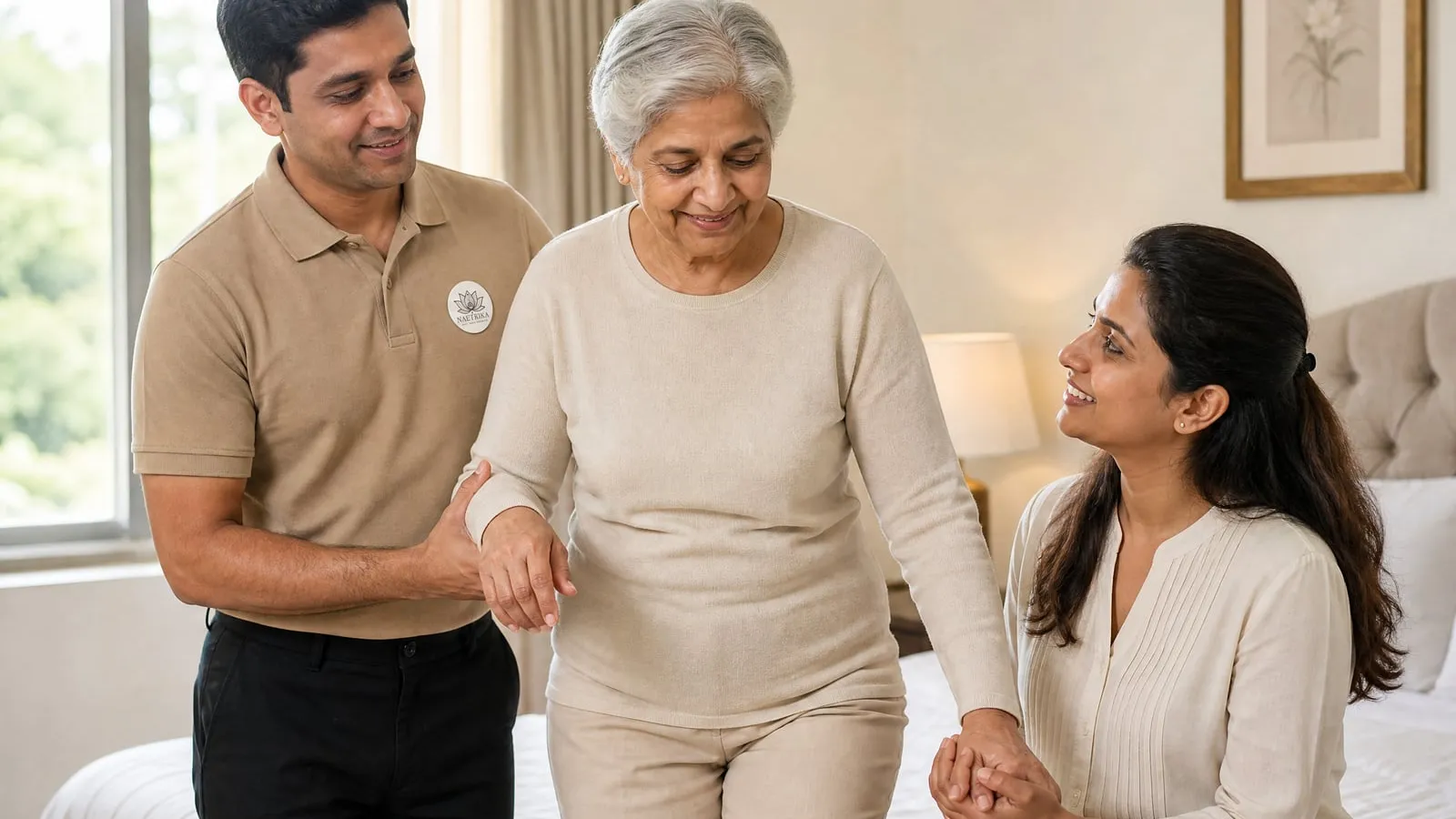
The Healing Power of Family: Why Recovering at Home Helps More Than Medicine
When a parent is discharged after a surgery or a hospital stay, the decision families weigh — home or a step-down facility — tends to get made almost entirely on clinical and logistical grounds: who can supervise medication, is there a nurse available, what does the doctor recommend. The emotional side of that decision, the fact that recovering surrounded by your own things, your own language, your own family, is not simply nicer but appears to measurably affect how the body heals, gets far less attention than it deserves. It’s worth taking seriously, because the evidence behind it is more substantial than “comfort” language usually suggests.
The science of connection is not vague
In 2010, a team led by psychologist Julianne Holt-Lunstad published a meta-analysis in PLOS Medicine pooling data from 148 separate studies covering more than 308,000 participants, looking at how the strength of a person’s social relationships predicted their likelihood of survival over time.1 The finding: people with stronger social relationships had a 50% greater likelihood of survival than those with weaker ones, an effect the authors describe as comparable in size to well-established risks like smoking, and larger than the effect of physical inactivity or obesity.1 When social integration was measured across multiple dimensions rather than just one, the effect was even larger — a 91% increase in odds of survival.1
50% greater likelihood of survival for people with stronger social relationships, an effect size on par with quitting smoking, according to a meta-analysis of 148 studies and over 308,000 participants published in PLOS Medicine.1
That’s a population-level finding about relationships and longevity generally, not a study of hospital recovery specifically, and it would be overstating it to claim otherwise. But it establishes something important as background: the presence of close relationships is not a soft or sentimental variable in health outcomes. It behaves, statistically, like a genuine medical risk factor, in either direction.
Stress measurably slows physical healing
There’s a more direct mechanism worth understanding, too. Psychologist Janice Kiecolt-Glaser and colleagues at Ohio State University have spent decades studying how psychological stress affects the body’s ability to repair itself, and one of their best-known findings involved married couples given small, standardised wounds and then asked to have a structured conversation, either a neutral one or a discussion of a disagreement in their marriage.2 Couples in the high-hostility group, whose conversations involved more conflict, healed at only 60% of the rate of low-hostility couples, and blood tests showed elevated levels of interleukin-6, an inflammatory marker linked to slower healing, at roughly 1.5 times the level found in the low-hostility group.2
The study was about marital conflict specifically, not about hospitals versus homes, and it would be inaccurate to present it as direct proof that home recovery heals wounds faster. What it does establish, published originally in The Lancet and replicated in various forms since, is that psychological stress is not just an unpleasant accompaniment to illness — it has a measurable physiological effect on how quickly the body repairs itself. A hospital ward, for many elderly Indian patients unfamiliar with the setting, disoriented by unfamiliar staff, food and routines, and often anxious about cost and about being a burden, is not a low-stress environment. A bedroom they’ve slept in for twenty years, with family nearby and food they recognise, plausibly is.
What happens when family is actually involved in care, not just visiting
Beyond the psychological research, there is direct clinical evidence on structured family involvement in a patient’s care and recovery. A review of clinical evidence on patient- and family-centred care in acute settings found that when families were actively involved, particularly around discharge education, several concrete recovery markers improved: patients had a lower incidence of lingering symptoms at the two-week mark, higher rates of returning to their baseline health status by four weeks, and dramatically better medication adherence — non-adherence dropped to roughly 9% in groups with structured family involvement, compared with roughly 38% without it.3 Patient satisfaction and follow-up visit rates were also consistently higher.3 It’s worth being balanced here too: the same body of evidence found the psychological benefits (reduced anxiety or stress specifically) were less consistent across different studies than the clinical and behavioural ones.3 The honest summary is that family involvement reliably helps with the practical mechanics of recovery — medication, follow-up, understanding what to do — and plausibly, though less consistently, helps with the emotional side too.
In studies of structured family involvement in patient care, medication non-adherence fell from roughly 38% to 9%, and patients were meaningfully more likely to have returned to their baseline health status by four weeks.3
What this looks like day to day, in an Indian household
Some of what makes home recovery easier is specific to Indian family life in a way Western research doesn’t always capture. It’s the food cooked the way it’s always been cooked, without having to explain dietary preferences to a hospital kitchen. It’s being able to speak in a mother tongue rather than translating discomfort into a second language. It’s grandchildren in the next room, or a temple corner in the house, or simply not having to adjust to the sounds and lighting of a ward at 2 a.m. None of that shows up in a discharge summary, but for a generation of Indian elders who grew up in joint or extended families, it is often what “feeling safe enough to actually rest” looks like.
Where professional support fits in, not against family
None of this is an argument against professional care, and it would be a disservice to pretend that love and presence alone are enough for genuinely medical needs like wound care, mobility support after a fracture, or monitoring vitals after a cardiac event. The honest picture is closer to the opposite: family involvement and professional care support the same outcome, and each is weaker without the other. Family provides the psychological safety and consistency the research above points to; a trained caregiver provides the clinical skill, catches what an untrained eye would miss, and, just as importantly, gives an exhausted family the rest they need so their presence stays genuinely supportive rather than becoming its own source of stress. Caregiver burnout among family members is real and well documented, and a parent recovering at home benefits very little if the adult child managing their care hasn’t slept properly in a week.
Creating a healing environment at home
A few practical things make a measurable difference, drawn from the research above: keep the same sleep and meal routine your parent had before, since consistency itself lowers stress. Keep the room calm and reasonably quiet rather than treating a full house as automatically better. Involve your parent in small decisions about their own care wherever possible, since a sense of control over recovery is consistently linked to better outcomes. And protect their dignity in daily tasks like bathing and dressing; this is exactly where a trained caregiver, rather than an anxious family member improvising, tends to make the most difference.
Recovering at home works best when family presence and professional care work together, not when one is expected to substitute for the other. Naetrika’s caregivers are trained to support recovery at home while keeping the family fully involved, not sidelined.
Frequently Asked Questions
Is recovering at home always better than a hospital or facility?
Does family presence really affect physical healing, or just how a patient feels?
How do we avoid family caregiver burnout while a parent recovers at home?
Sources
- 1. Holt-Lunstad, J., Smith, T.B., Layton, J.B., "Social Relationships and Mortality Risk: A Meta-analytic Review," PLOS Medicine, 2010 (148 studies, 308,849 participants).
- 2. Kiecolt-Glaser, J. et al., "Slowing of Wound Healing by Psychological Stress," originally published in The Lancet, 1995; summarised in "Stress Substantially Slows Human Body's Ability to Heal," Ohio State University News.
- 3. "Patient- and Family-Centered Care Initiatives in Acute Care Settings: A Review of the Clinical Evidence," NCBI Bookshelf, National Library of Medicine.
More From Naetrika
Have a Question About Your Family's Situation?
Every family's situation is different. Talk to our care team for guidance specific to yours — free, no obligation.